
If you have ever been awake at 3.14am with one pillow under your bump, another between your knees and a third behind your back, you know the cruel arithmetic of late pregnancy: the more exhausted you are, the harder it gets to lie comfortably enough to sleep.
“Pregnant, can’t sleep” is one of the most searched phrases in pregnancy, and the reason is not a mystery. Around week 24 the bump gets heavy enough to pull on your lower back. Hips ache from one side too long. You are told to stop sleeping on your back. And every pillow in the house was designed to hold up a head.
- Ordinary pillows flatten and slide, so support under your bump disappears within an hour.
- Side sleeping is what guidance encourages late in pregnancy. Staying there while asleep is the hard part.
- A contoured maternity pillow holds the bump and the knees at once, which keeps hips and spine in line.
Short on time? The Snuggi Body Align Pillow is 40% off today, $59.99 instead of $99.99.
The 3am problem nobody warns you about
Pregnancy insomnia gets blamed on hormones, heartburn and getting up three times a night. Those are real. But ask women in their third trimester and a different complaint comes first: they simply cannot get comfortable.

The pattern is always the same. You build a fort from whatever pillows are in the house. It works for twenty minutes. Then the one under your bump squashes flat, the one between your knees slips out, and you wake to rebuild the whole thing, four or five times a night.
Why a pillow stack stops working around week 24
A standard pillow is filled and shaped for five kilograms of head, lying still. A bump is a different proposition: heavier, lower, wider, and it moves with you every time you roll.
- It flattens. Standard fill compresses under the weight of a bump within minutes, so the gap you were trying to fill comes back.
- It slides. Nothing holds a rectangular pillow between your knees once you relax into sleep.
- It only solves one thing at a time. Support the bump and your knees are unsupported; support the knees and your bump hangs forward, tugging on your back.
- It takes over the bed. Most women end up with three or four pillows in play, which is how partners end up on the couch.
The position that matters most, and why it is so hard to hold
Health guidance in Australia and the UK encourages pregnant women to settle to sleep on their side from around 28 weeks rather than flat on their back. The reasoning is mechanical: on your back, the weight of the uterus presses on the large blood vessels along your spine, which can reduce the blood and oxygen reaching the placenta. On your side, left or right, that weight comes off.

Here is the part the advice skips: nobody controls their position for eight hours. You settle on your side and wake on your back at 4am. What changes the odds is not willpower, it is having something physically holding the position, so rolling backwards takes effort instead of happening by default.
“I stopped waking up to rearrange pillows. That was the whole difference. I wasn’t resettling five times a night anymore.”
How a contoured maternity pillow changes the maths
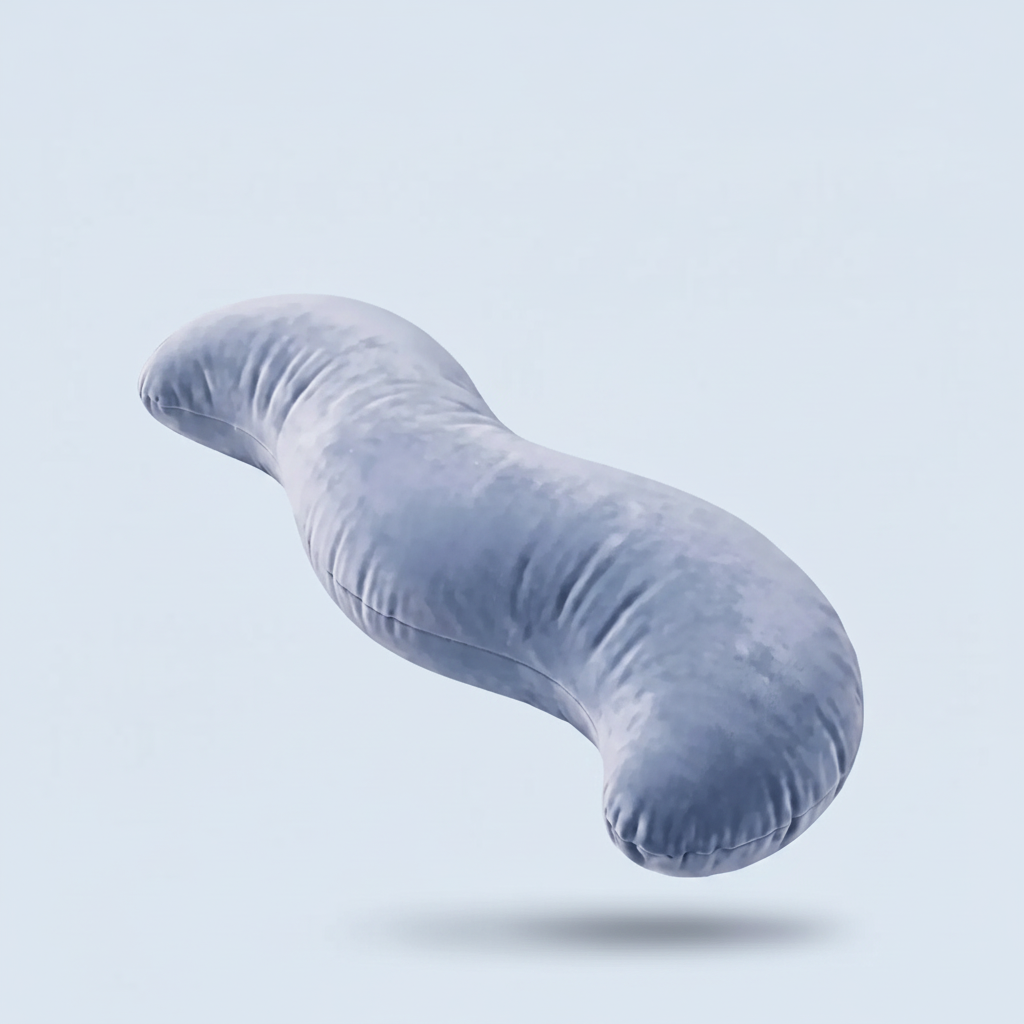
This is the gap the Snuggi Body Align Pillow was shaped for. Instead of a rectangle, it is one continuous S-curve: a high upper curve that fills the space between bump and mattress, a narrow waist, and a lower curve that sits between your knees. One pillow doing three jobs, which is why it stays where you put it.
Holds the bump
The upper curve carries the weight of your bump rather than letting it pull forward on your lower back and ligaments.
Stacks your hips
The lower curve keeps knees apart and hips level, so the pelvis and spine stay neutral, which is where most third-trimester hip ache starts.
Keeps you on your side
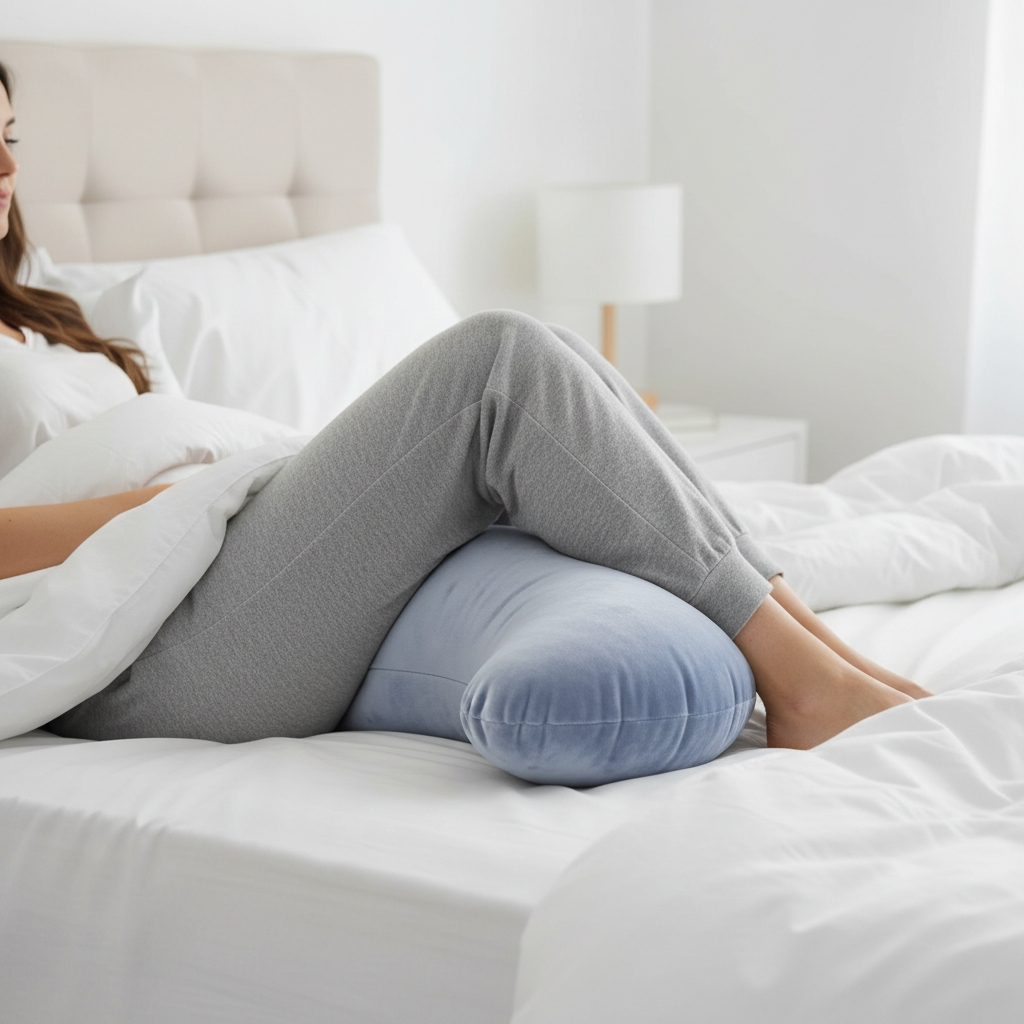
Because you hug it, rolling onto your back means moving the pillow first, a gentle cue that encourages the position you are aiming for.
It also has to survive the night
Support only counts if it is still there at 4am. The Snuggi uses high-loft resilient fibre rather than soft polyester fluff, so it cushions without collapsing, and it is slim enough through the waist that it does not annex your partner’s half of the bed. Most women keep using it well after the birth as a feeding arm rest.
Getting the position right on the first night
Most women get it wrong on night one by treating it like a normal pillow and lying on top of it. Three steps is all it takes:
-
1
Lie on your side and tuck the upper curve under your bump, so it makes contact rather than sitting in front of you.
-
2
Slide the lower curve between your knees and let your top leg rest forward over it, so your hips stay stacked.
-
3
Hug the top with your arm. If you want to swap sides in the night, take the pillow with you, since it works from either side.
Snuggi vs the alternatives
Swipe the table to compare
| Snuggi | Pillow stack | Full-size U pillow | |
|---|---|---|---|
| Supports bump and knees at once | |||
| Stays in place all night | |||
| Leaves room for your partner | |||
| Easy to swap sides with | |||
| Still useful after the birth |